10 Common Acne Myths You Should Stop Believing (Backed by Science)

Updated: Jul 11
Introduction
Acne is one of the most common skin conditions in the world, affecting teenagers and adults alike.
Yet despite decades of scientific research, countless myths about acne continue to circulate on social media, in beauty blogs, and through well-meaning advice from friends and family.
You've probably heard statements like "Toothpaste dries out pimples," "Only teenagers get acne," or "Washing your face more often will clear your skin." While these claims may sound convincing, many of them are not supported by scientific evidence.
In fact, believing these myths can delay proper treatment, damage your skin barrier, and even make breakouts worse.
The truth is that acne is a complex medical condition influenced by hormones, genetics, excess oil production, inflammation, and bacteria—not by a single habit or food.
Understanding what actually causes acne is the first step toward building an effective skincare routine.
In this guide, we'll separate fact from fiction by examining ten of the most common acne myths using current scientific knowledge.
You'll learn why people believe these myths, what research actually says, and what you should do instead for healthier, clearer skin.
What Actually Causes Acne?
Before debunking common acne myths, it's important to understand what really causes acne.
Acne develops when four main factors work together:
Excess Oil (Sebum) Production
Your skin naturally produces oil to keep itself moisturized. However, hormonal changes—especially during puberty, menstruation, pregnancy, or periods of stress—can cause your oil glands to produce too much sebum.
Clogged Pores
Dead skin cells normally shed from the skin's surface. When these cells mix with excess oil, they can clog hair follicles, leading to whiteheads and blackheads.
Acne-Causing Bacteria
A bacterium called Cutibacterium acnes naturally lives on healthy skin. When pores become blocked, this bacteria can multiply rapidly and trigger inflammation.
Inflammation
Your immune system responds to blocked pores and bacterial growth by creating inflammation, which leads to red, swollen, and sometimes painful pimples.
Other factors that can contribute to acne include:
Genetics
Hormonal fluctuations
Certain medications
High-friction clothing or helmets
Some cosmetic products
Chronic stress
Knowing these real causes makes it much easier to identify which acne advice is based on evidence—and which is simply a myth.
If you're consistently following a skincare routine but still getting breakouts, there may be underlying factors such as hormones, genetics, or lifestyle habits. Learn more in our guide on Why Am I Getting Pimples Even After Following a Skincare Routine?

Myth 1: Toothpaste Can Dry Out Pimples
Why People Believe It
For years, toothpaste has been promoted as a quick home remedy for pimples because it creates a drying sensation.
Older toothpaste formulas even contained ingredients with mild antibacterial properties, leading many people to believe they could treat acne.
The Truth
Modern toothpaste is designed for teeth—not skin.
Many toothpaste formulas contain ingredients such as menthol, baking soda, hydrogen peroxide, flavoring agents, and detergents that can irritate the skin.
While toothpaste may temporarily dry the surface of a pimple, it does not treat the underlying causes of acne.
Instead, it may cause:
Skin irritation
Redness and burning
Dry patches
Contact dermatitis
Post-inflammatory hyperpigmentation
Dermatologists generally do not recommend toothpaste as an acne treatment.
What You Should Do Instead
Instead of toothpaste, use products specifically formulated for acne-prone skin.
Evidence-based ingredients include:
Benzoyl peroxide
Salicylic acid
Adapalene
Azelaic acid
These ingredients target clogged pores, acne-causing bacteria, or inflammation without unnecessarily damaging the surrounding skin.
One of the biggest skincare myths is that stronger products always clear acne faster. In reality, excessive use of exfoliants and acne treatments can compromise your skin barrier, increasing irritation and making acne harder to manage. Before adding more products, learn how to repair your skin barrier with our comprehensive guide.
Myth 2: Oily Skin Doesn't Need Moisturizer
Why People Believe It
Many people assume that adding moisturizer to already oily skin will make it even greasier and lead to more breakouts.
This misunderstanding causes countless people with oily skin to skip moisturizer entirely.
The Truth
Oily skin can still become dehydrated.
When you avoid moisturizer or use harsh cleansers that strip away natural oils, your skin may respond by producing even more sebum to compensate.
A damaged skin barrier can also increase irritation, redness, and sensitivity—especially if you're using acne treatments like retinoids or benzoyl peroxide.
Modern moisturizers designed for oily or acne-prone skin are lightweight, fast-absorbing, and non-comedogenic, meaning they are formulated not to clog pores.
What You Should Do Instead
Choose a moisturizer that is:
Oil-free
Non-comedogenic
Fragrance-free (if your skin is sensitive)
Lightweight gel or lotion based
Applying moisturizer twice daily helps support your skin barrier while allowing acne treatments to work more effectively.
A moisturizer is just one part of an effective routine. Read our complete guide on How to
Build a skincare Routine for Acne-Prone Skin
to create a routine that supports clearer skin.

Myth 3: Washing Your Face More Often Clears Acne
Why People Believe It
Since acne often appears alongside oily skin, it's easy to assume that dirt is causing pimples. Many people believe washing their face repeatedly throughout the day will remove oil and prevent breakouts.
The Truth
Acne is not caused by dirty skin.
Overwashing strips away your skin's natural protective barrier. This can lead to dryness, irritation, inflammation, and sometimes increased oil production as your skin tries to restore balance. Excessive cleansing can also make prescription acne treatments more irritating.
Dermatologists generally recommend cleansing only twice daily—once in the morning and once before bed—and after heavy sweating.
What You Should Do Instead
Develop a gentle cleansing routine by:
Washing your face morning and evening
Using a mild cleanser formulated for acne-prone skin
Avoiding harsh scrubs
Patting your skin dry instead of rubbing
Following cleansing with moisturizer
Consistency is far more effective than frequent washing.
Myth 4: Popping Pimples Helps Them Heal Faster
Why People Believe It
When you pop a pimple, it often looks smaller immediately, making it seem like you've solved the problem. Many people also believe that removing the pus helps the skin heal faster.
The Truth
Popping pimples usually does more harm than good.
Squeezing a pimple can push bacteria, oil, and debris deeper into the skin, increasing inflammation.
This may lead to:
Larger, more painful pimples
Longer healing time
Permanent acne scars
Dark spots (post-inflammatory hyperpigmentation)
Secondary skin infections
Deep or cystic acne is especially risky to squeeze because the inflammation occurs beneath the skin's surface.
What You Should Do Instead
If you have a whitehead or inflamed pimple:
Apply a spot treatment containing benzoyl peroxide or salicylic acid.
Cover it with a hydrocolloid acne patch to protect it from picking.
Let it heal naturally.
If you frequently develop painful cystic acne, consult a dermatologist instead of trying to remove it yourself.
Myth 5: Sunlight Clears Acne
Why People Believe It
Many people notice that their skin appears slightly clearer after spending time in the sun. UV exposure can temporarily dry the skin and reduce redness, creating the illusion that acne has improved.
The Truth
Sunlight is not an acne treatment.
While sun exposure may temporarily reduce inflammation, it can also:
Damage the skin barrier
Increase the risk of skin cancer
Cause premature skin aging
Trigger dark acne marks to become even darker
Dry out the skin, leading to increased oil production later
Some acne medications also make your skin much more sensitive to sunlight, increasing the risk of sunburn.
Sun exposure can make post acne marks appear darker and last longer. Learn why this happens in Why Acne MarksTake So Long to fade?
What You Should Do Instead
Protect your skin every day by:
Applying a broad-spectrum SPF 30 or higher sunscreen.
Choosing a lightweight, non-comedogenic sunscreen if you have oily or acne-prone skin.
Wearing hats or seeking shade during peak sunlight hours.
Healthy skin starts with protection, not excessive sun exposure.
Myth 6: Chocolate Always Causes Acne
Why People Believe It
For decades, parents blamed chocolate whenever teenagers developed pimples. Since breakouts often occur during adolescence, chocolate became an easy target.
The Truth
Chocolate itself is not a proven direct cause of acne.
Current research suggests that acne is more closely linked to an overall dietary pattern than to a single food
.
Some studies indicate that diets high in refined carbohydrates and foods with a high glycemic index may worsen acne in certain individuals. There is also emerging evidence that excessive dairy intake may contribute to breakouts for some people
.
However, dark chocolate in moderation has not been conclusively shown to cause acne in everyone. Everyone's skin responds differently.
What You Should Do Instead
Instead of eliminating chocolate completely:
Eat a balanced diet rich in fruits, vegetables, whole grains, legumes, nuts, and seeds.
Stay hydrated.
Observe whether certain foods consistently trigger your own breakouts.
Focus on long-term healthy eating rather than blaming individual foods.

Myth 7: Makeup Always Causes Breakouts
Why People Believe It
Many people notice pimples after wearing makeup and assume cosmetics are automatically responsible for acne.
The Truth
Not all makeup causes breakouts.
Modern cosmetic products are often labeled as:
Non-comedogenic
Oil-free
Fragrance-free
Suitable for acne-prone skin
These formulations are designed to reduce the likelihood of clogged pores.
However, problems can occur if you:
Sleep with makeup on.
Use expired cosmetics.
Share makeup products.
Rarely clean makeup brushes or sponges.
These habits allow bacteria, oil, and dirt to accumulate, increasing the risk of breakouts.
What You Should Do Instead
You can wear makeup safely by:
Choosing non-comedogenic products.
Removing makeup thoroughly every night.
Washing brushes and beauty sponges regularly.
Replacing old makeup according to its expiration period.
Using gentle cleansers after wearing heavy makeup.
Makeup itself isn't usually the problem—poor hygiene and unsuitable products are.
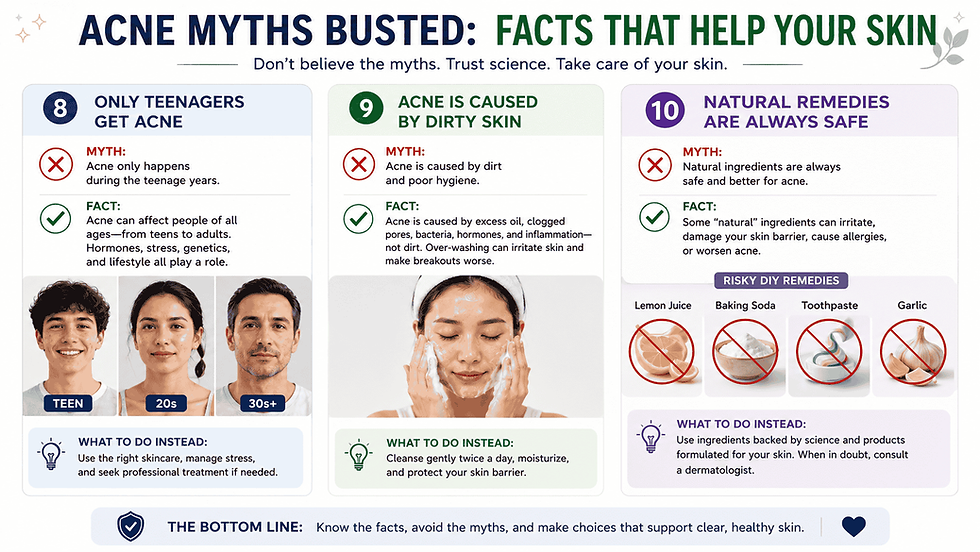
Myth 8: Only Teenagers Get Acne
Why People Believe It
Acne is strongly associated with puberty because hormonal changes during the teenage years often trigger breakouts. As a result, many people assume acne disappears once you become an adult.
The Truth
Acne can affect people of all ages. Many adults continue to experience acne into their 20s, 30s, 40s, and even beyond.
Adult acne is especially common among women due to hormonal fluctuations related to menstruation, pregnancy, menopause, or conditions such as hormonal imbalances.
Stress, certain medications, cosmetics, and genetics can also contribute to adult acne.
What You Should Do Instead
If you're experiencing acne as an adult:
Follow a consistent skincare routine.
Use evidence-based acne treatments.
Avoid picking at blemishes.
Consult a dermatologist if your acne is persistent, painful, or leaving scars.
Adult acne is common, and effective treatments are available.

Myth 9: Acne Is Caused by Dirty Skin
Why People Believe It
Since acne appears on oily skin, it's easy to assume that dirt is clogging the pores.
The Truth
Acne is not caused by poor hygiene. The main causes of acne are excess oil production, clogged pores, bacteria, inflammation, genetics, and hormones—not dirt.
Scrubbing your face aggressively or washing it repeatedly can actually damage your skin barrier, leading to irritation and worsening breakouts.
What You Should Do Instead
Maintain a gentle skincare routine by:
Washing your face twice daily.
Using a mild cleanser suitable for your skin type.
Avoiding harsh scrubs.
Moisturizing regularly.
Wearing sunscreen every day.
Healthy skin depends on balance, not excessive cleansing.
Myth 10: Natural Remedies Are Always Safe for Acne
Why People Believe It
Many people believe that if an ingredient is "natural," it must be safer than scientifically formulated skincare products.
Social media often promotes DIY treatments using ingredients like lemon juice, baking soda, toothpaste, garlic, or undiluted essential oils.
The Truth
Natural does not always mean safe. Some popular home remedies can irritate the skin, cause burns, trigger allergic reactions, damage the skin barrier, and increase post-acne pigmentation.
For example:
Lemon juice is highly acidic and may cause irritation and photosensitivity.
Baking soda disrupts the skin's natural pH.
Garlic may cause chemical burns when applied directly.
What You Should Do Instead
Choose products supported by scientific evidence and formulated for facial skin. If you'd like to try natural ingredients, discuss them with a dermatologist first and always perform a patch test before applying them to your face.
Instead of relying on home remedies like toothpaste, choose products with ingredients backed by research. Our guide to Best Skincare Ingredients for Acne-Prone Skin explains which ingredients work best and how to use them.
Common Acne Mistakes to Avoid
Even if you don't believe acne myths, certain everyday habits can make breakouts worse.
Avoid these common mistakes:
Picking or squeezing pimples.
Sleeping with makeup on.
Skipping moisturizer because your skin feels oily.
Overwashing your face.
Using harsh physical scrubs.
Trying multiple new products at the same time.
Expecting overnight results from acne treatments.
Forgetting to wear sunscreen.
Touching your face frequently.
Not cleaning makeup brushes, pillowcases, or phone screens regularly.
Healthy skin comes from consistency rather than constantly changing products.
Frequently Asked Questions (FAQs)
1. How long does acne treatment take to work?
Most evidence-based acne treatments take 6 to 12 weeks to show noticeable improvement. It's important to stay consistent and avoid switching products too quickly.
2. Can stress cause acne?
Stress doesn't directly cause acne, but it can increase inflammation and influence hormone levels, making existing acne worse in many people.
3. Should I moisturize if I have oily skin?
Yes. Even oily skin needs hydration. Using a lightweight, non-comedogenic moisturizer helps protect your skin barrier and may even reduce excess oil production over time.
4. Is it okay to wear sunscreen if I have acne?
Absolutely. Choose a broad-spectrum SPF 30 or higher sunscreen labeled as non-comedogenic or suitable for acne-prone skin. Daily sun protection helps prevent dark spots and supports overall skin health.
5. When should I see a dermatologist?
Consider seeing a dermatologist if:
Your acne is painful or cystic.
Over-the-counter treatments haven't helped after several weeks.
Your acne is leaving scars.
Breakouts are affecting your confidence or daily life.
Early treatment can reduce the risk of permanent scarring.
6. Can acne be cured permanently?
There isn't a universal permanent cure for acne because its causes vary from person to person. However, with the right skincare routine, lifestyle habits, and medical treatment when needed, most people can successfully manage acne and keep breakouts under control.

Conclusion
Acne myths have been passed down for generations, but scientific research paints a much clearer picture. From toothpaste and excessive face washing to sunlight and chocolate, many popular beliefs simply don't hold up when examined closely.
The key to healthier skin isn't following viral skincare hacks—it's understanding how acne actually develops and choosing treatments backed by evidence. A gentle cleanser, a suitable moisturizer, daily sunscreen, and proven acne-fighting ingredients are far more effective than quick fixes or DIY remedies.
Remember that everyone's skin is different, and what works for one person may not work for another. Be patient with your skincare routine, give products enough time to work, and don't hesitate to seek professional advice if your acne is severe or persistent.
By replacing myths with facts, you can make informed decisions, protect your skin barrier, and move one step closer to healthier, clearer skin.


Comments