Retinol for Beginners: How to Start Retinol Safely Without Irritating Your Skin

Updated: Sep 3
Retinol has become one of the most talked-about skincare ingredients for smoother, clearer, brighter-looking skin. It can help with several common concerns, including fine lines, uneven skin texture, clogged pores, acne and dark spots.
But if you have never used retinol before, knowing which retinol to use, how often to apply retinol, what percentage of retinol is best for beginners, and what skincare ingredients to avoid with retinol can feel overwhelming.
The good news? You do not need an elaborate routine to introduce retinol. Starting with a gentle formula, using it slowly and protecting your skin barrier can make the process much easier.
This beginner-friendly guide explains how to start using retinol, what to expect during the first few weeks, common mistakes to avoid and how to build a simple retinol skincare routine.
Important: Retinol is a topical vitamin A derivative. If you are pregnant, trying to become pregnant or breastfeeding, speak with your healthcare provider before using retinoid products.

What Is Retinol?
Retinol is a type of retinoid, a family of vitamin A-derived skincare ingredients. Retinoids can influence skin-cell turnover and are used for concerns such as acne, uneven skin tone, fine lines and texture.
Unlike prescription retinoids such as tretinoin, retinol is commonly found in over-the-counter skincare products. It generally needs to undergo conversion within the skin before becoming the active form that affects skin cells.
This is one reason retinol for beginners can be a reasonable starting point for someone who wants to introduce a vitamin A ingredient gradually.
However, stronger does not automatically mean better. The goal is to find a product and frequency that your skin can tolerate consistently.

What Does Retinol Do for Your Skin?
Retinol is popular because it can target several skin concerns at once.
1. Helps Improve Uneven Skin Texture
Regular retinoid use can encourage skin-cell turnover and may help skin appear smoother and more refined over time.
If your main concern is rough skin texture or small bumps, retinol may eventually become a useful addition to your routine.
2. Helps With Clogged Pores
Retinoids can help prevent pores from becoming clogged, which is one reason they are commonly used in acne treatment.
This makes retinol particularly interesting for people dealing with occasional breakouts, blackheads or congested-looking skin.
However, if you have moderate or severe acne, painful cysts or persistent breakouts, it is better to consult a dermatologist rather than relying solely on cosmetic retinol.
3. Can Help With Dark Spots
Retinoids can help improve certain forms of discoloration and post-acne dark spots by encouraging skin turnover.
That makes retinol for hyperpigmentation and acne marks a commonly searched skincare topic.
But there is an important distinction: retinol is not an instant dark-spot remover. Hyperpigmentation can have different causes, and sunscreen remains essential when treating discoloration.
4. Supports Smoother-Looking, Younger-Looking Skin
Retinoids are also widely used in anti-aging skincare. They can help improve the appearance of fine lines, uneven texture and other signs associated with skin aging.
The key word is consistent. Retinol is not an overnight treatment.
When Should You Start Using Retinol?
There is no universal age at which everyone needs to start retinol.
If your primary concern is acne, clogged pores or post-acne marks, a retinoid may be considered based on your specific skin concerns.
If you are interested in retinol mainly for prevention and early signs of skin aging, your routine should still be based on your skin's needs rather than a particular birthday.
A simple skincare routine with a gentle cleanser, moisturizer and broad-spectrum sunscreen is more important than rushing into multiple active ingredients.
What Percentage of Retinol Should Beginners Use?
One of the most common questions is:
“What percentage of retinol should I use as a beginner?”
There is no single percentage that is appropriate for everyone because formulations differ, and the percentage listed on a product does not tell the whole story about how irritating that product will be.
For someone completely new to retinol, a low-strength retinol product is generally a more sensible starting point than immediately choosing a highly concentrated formula.
Instead of chasing the highest percentage, prioritize:
A reputable formulation
A product designed for beginners or sensitive skin
A simple ingredient list
A product that you can tolerate consistently
Proper sun protection
Your skin does not get extra points for surviving an unnecessarily strong retinol.

How to Start Using Retinol for the First Time
If you are wondering how to introduce retinol into your skincare routine, start slowly.
Step 1: Patch Test
Before applying a new retinol product all over your face, patch test it on a small area of skin.
Cleveland Clinic recommends testing a small area first and watching for an adverse reaction before incorporating retinol into your routine.
Step 2: Use Retinol at Night
Retinol is generally used in the evening.
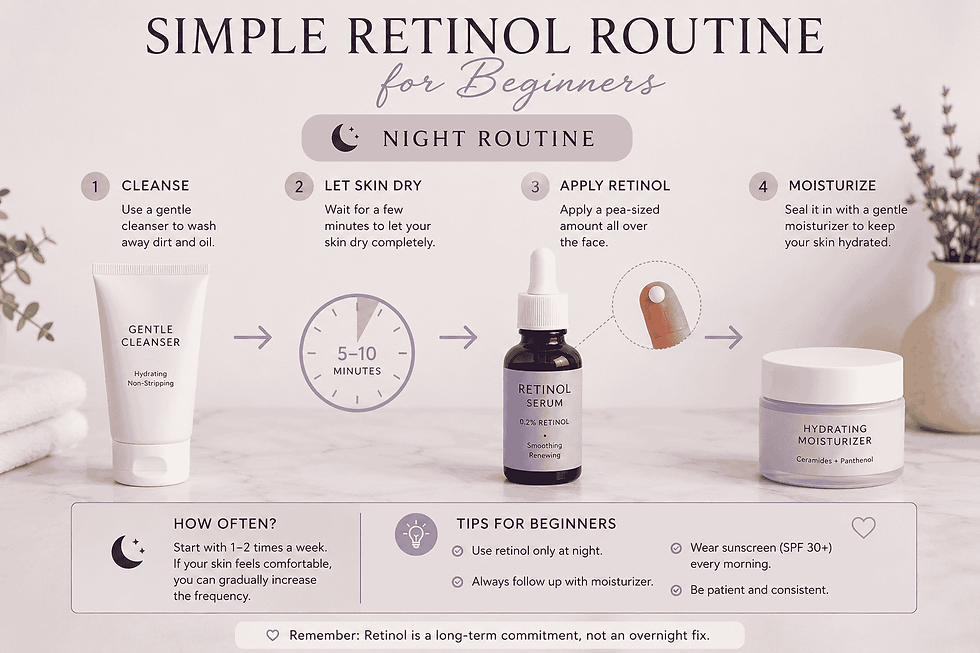
Start with clean, dry skin and apply a small amount of product. Cleveland Clinic recommends approximately a pea-sized amount for the entire face rather than applying a large quantity.
Avoid getting it directly into your eyes, lips and the creases around your nose.
Step 3: Start Once or Twice a Week
Do not begin by applying retinol every night.
For a retinol beginner skincare routine, starting once or twice a week can give your skin time to adjust.
If your skin remains comfortable after several weeks, you can gradually increase the frequency.
The exact schedule should depend on the product instructions and how your skin responds.
Step 4: Moisturize
Finish with a gentle moisturizer.
If your skin is particularly sensitive or dry, you can use the retinol sandwich method:
Moisturizer → retinol → moisturizer
This can make introducing retinol more comfortable for some people.
Dermatologists may also recommend moisturizer as part of strategies for reducing irritation from topical retinoids.
A Simple Retinol Skincare Routine for Beginners
You do not need ten products.
Retinol Night Routine
1. Gentle cleanser
Wash your face without scrubbing.
2. Let your skin dry
Retinol can be irritating, so avoid applying it immediately after aggressive cleansing.
3. Retinol
Apply a small, pea-sized amount over the face.
4. Moisturizer
Use a simple, fragrance-free or gentle moisturizer if your skin is easily irritated.
Morning Routine
The next morning, keep things simple:
Cleanser → moisturizer → broad-spectrum sunscreen
Using sunscreen is particularly important when incorporating retinoids into your routine. Dermatologists recommend broad-spectrum SPF 30 or higher and other sun-protection measures when using topical retinoids.
If you are working on retinol for dark spots, skipping sunscreen can undermine your overall pigmentation routine.
If pigmentation is your primary concern and you're considering other targeted ingredients alongside retinol, learn more about alpha arbutin vs kojic acid before adding another active.
What Happens When You First Start Retinol?
Some people experience an adjustment period.
Possible side effects include:
Dryness
Redness
Peeling
Flaking
Itching
Burning or stinging
Increased sensitivity
These effects can occur when your skin is adapting to retinol.
Mild dryness does not necessarily mean that retinol is permanently unsuitable for you. However, significant burning, swelling or persistent irritation is a reason to stop and seek professional advice.
If your skin becomes very irritated, do not try to “push through” it.
More irritation does not mean better results.
What Is Retinol Purging?
You may have heard of retinol purging, where breakouts supposedly become worse before they improve.
Retinoids can influence clogged pores and acne, but not every breakout after starting retinol should automatically be dismissed as purging.
If you develop severe irritation, widespread rash-like bumps, intense burning or breakouts in areas where you normally do not experience acne, stop and reassess the product.
Persistent or severe acne should be evaluated by a dermatologist.
What Skincare Ingredients Should You Avoid With Retinol?
One of the biggest beginner mistakes is adding several strong active ingredients at the same time.
When starting retinol, you may want to avoid using it in the same routine with potentially irritating exfoliating ingredients until your skin has adjusted.
These can include:
Glycolic acid
Lactic acid
Salicylic acid
Strong exfoliating products
Other retinoids
Harsh scrubs
This does not necessarily mean these ingredients can never be used in the same overall skincare routine. The issue is that combining multiple potentially irritating actives immediately can make it much harder to identify what is causing irritation.
A simple routine is usually easier when you are starting retinol for the first time.
Can You Use Vitamin C With Retinol?
Yes, vitamin C and retinol can both have a place in a skincare routine, but beginners do not need to apply them together.
A simple approach is:
Morning: Vitamin C → moisturizer → sunscreen
Night: Retinol → moisturizer
Separating them can make your routine easier to tolerate, particularly if you are new to active ingredients.
Vitamin C is also used for concerns such as dark spots and photoaging.
If you are a beginner & unsure which vitamin C serum to choose for your skin type then check out our guide Discover 7 best Vitamin C serum for hyperpigmentation.
Can You Use Niacinamide With Retinol?
Niacinamide and retinol can generally be incorporated into the same skincare routine.
For beginners, niacinamide can be useful because it is commonly included in products designed to support the skin barrier and hydration.
However, you do not need to add niacinamide simply because you are using retinol.
If your moisturizer already contains niacinamide, there is no need to buy another serum just to create a more complicated routine.
If you want to include niacinamide serum into your skincare routine then here is the guide that mentions best niacinamide serum Learn top 6 Niacinamide Serum for Hyperpigmentation.
Can You Use Hyaluronic Acid With Retinol?
Hyaluronic acid is a hydrating ingredient and can be used alongside retinol.
If retinol makes your skin feel dry, a hydrating serum followed by moisturizer may make your routine more comfortable.
The important thing is to focus on hydration rather than continuously adding more active ingredients.
Common Retinol Mistakes Beginners Should Avoid
1. Starting Every Night
This is probably the most common mistake.
Your skin does not need daily retinol from day one.
Start slowly and increase frequency only if your skin tolerates it.
2. Using Too Much Retinol
More product does not mean faster results.
A pea-sized amount is generally sufficient for the face.
3. Applying Retinol to Irritated Skin
If your skin is sunburned, cracked or already irritated, adding retinol can make the problem worse.
Cleveland Clinic recommends avoiding retinol when the skin is sunburned, broken or irritated.
4. Skipping Moisturizer
Retinol beginners sometimes avoid moisturizer because they think it will interfere with the ingredient.
That is unnecessary.
A well-moisturized skin barrier can make a retinol routine easier to tolerate.
5. Forgetting Sunscreen
This is a major mistake.
If you are using retinol to improve uneven skin tone, dark spots or signs of sun damage, daily sunscreen should be a non-negotiable part of your routine.
6. Changing Products Too Quickly
Retinol requires patience.
Constantly switching between different products makes it difficult to know what works and can increase irritation.
Give your routine time before deciding that it has failed.

How Long Does Retinol Take to Work?
Do not expect dramatic changes after one week.
Retinol works gradually, and results depend on the product, concentration, frequency of use, your skin and the concern being treated.
For acne, dermatologists commonly recommend giving an acne treatment several weeks of consistent use before judging its effectiveness.
For texture, pigmentation and fine lines, noticeable improvements can also take time.
Think in terms of weeks to months, not days.
Is Retinol Good for Sensitive Skin?
Sensitive skin does not automatically mean you can never use retinol.
However, you should be considerably more cautious.
Start with a gentle formula, use it less frequently and focus heavily on moisturizing.
If you already have significant irritation, eczema, rosacea or another skin condition, talk to a dermatologist before introducing retinol.
There is no benefit in forcing an ingredient your skin cannot tolerate.
Who Should Not Use Retinol?
If you are pregnant or trying to become pregnant, talk to your healthcare provider before using retinoid products.
Healthcare providers generally discourage retinoid use during pregnancy because of potential risks.
If you are breastfeeding, discuss topical retinoid use with your healthcare provider as well.
You should also speak with a dermatologist if you have a significant skin condition, severe acne or persistent irritation.
Beginner Retinol Routine: A Simple Weekly Schedule
If you are completely new to retinol, your routine could look something like this:
Monday: Retinol
Tuesday: Moisturizer only
Wednesday: Moisturizer only
Thursday: Retinol
Friday: Moisturizer only
Saturday: Moisturizer only
Sunday: Moisturizer only
This is only an example, not a universal prescription. If your skin becomes irritated, reduce the frequency or stop and allow your skin to recover.
Once your skin has adapted, you can gradually increase frequency if appropriate.
Final Thoughts
Retinol can be an excellent addition to a skincare routine, but starting retinol slowly is more important than starting with a strong product.
If you are a beginner, focus on four things:
Choose a gentle retinol formula.
Start once or twice a week.
Moisturize consistently.
Wear broad-spectrum sunscreen every morning.
Do not combine every active ingredient at once, do not use excessive amounts and do not judge the product after a few days.
The best retinol skincare routine for beginners is not the most complicated one. It is the routine you can tolerate and follow consistently.
And if your skin is already irritated, painful or unusually sensitive, retinol does not have to be your next step. Sometimes the smartest skincare move is to simplify your routine first.
Frequently Asked Questions
Can I use retinol every night as a beginner?
It is better to start gradually rather than immediately using retinol every night. Increase frequency only if your skin tolerates it.
What should I apply after retinol?
A gentle moisturizer is usually a good choice. Avoid immediately layering multiple strong active ingredients.
Should I use retinol in the morning or at night?
Retinol is generally used at night. During the day, prioritize broad-spectrum sunscreen.
Can retinol remove acne scars?
Retinoids may make some mild acne scarring less noticeable, but deeper depressed scars often require professional treatments.
Can retinol get rid of dark spots?
Retinoids can help improve certain types of discoloration and post-acne dark spots, but results are gradual. Consistent sun protection is also essential.
Is retinol suitable for teenagers?
Retinol is not automatically necessary simply because someone is a teenager. If acne is the concern, evidence-based acne treatments such as adapalene may be more appropriate, depending on the individual situation. A dermatologist can help determine the right option.
Can I use retinol with niacinamide?
Yes, these ingredients can generally be used together. However, beginners should prioritize a simple routine rather than adding multiple products unnecessarily.
What is the best retinol for beginners?
Rather than choosing a product solely because it has the highest concentration, look for a reputable, low-strength formula that suits your skin type and can be introduced gradually.


Comments