Best Vitamin C Serum for Hyperpigmentation: 7 Top Picks for Dark Spots
Updated: Aug 20
Introduction
If dark spots, acne marks, or uneven skin tone are making your complexion look dull, adding a vitamin C serum for hyperpigmentation to your routine can be a useful step.
Vitamin C is an antioxidant that can help brighten the appearance of skin and address pigmentation associated with environmental exposure and excess melanin production.
However, not every vitamin C serum is formulated in the same way. The type of vitamin C, concentration, supporting ingredients, packaging, and your skin's tolerance all matter.
So, what is the best vitamin C serum for hyperpigmentation?
There isn't one product that works for everyone. A person with oily, acne-prone skin may prefer a lightweight serum, while someone with sensitive or dry skin may need a gentler vitamin C derivative.
In this guide, we'll cover the best options, what to look for when buying a vitamin C serum for dark spots, how to use it, and mistakes that can make pigmentation harder to manage.

What Does Vitamin C Do for Hyperpigmentation?
Vitamin C is mainly valued in skincare for its antioxidant and brightening properties.
When applied topically, vitamin C can help interfere with processes involved in melanin production while also helping protect the skin against oxidative stress.
This makes it particularly interesting for people dealing with dark spots, post-acne pigmentation, and uneven skin tone.
It can be useful for:
Post-inflammatory hyperpigmentation
Acne marks
Sun-related pigmentation
Dull-looking skin
Uneven skin tone
Mild discoloration
However, vitamin C isn't an instant pigmentation remover.
If you're searching for a vitamin C serum that removes dark spots in a few days, it's important to adjust your expectations. Pigmentation usually takes weeks to months to improve, and the cause of the pigmentation matters.
Daily sunscreen is also essential because UV exposure can contribute to pigmentation and make existing dark spots more persistent. Vitamin C should complement sunscreen, not replace it.

Best Vitamin C Serums for Hyperpigmentation
Here are some options worth considering if you're looking for a vitamin C serum for dark spots and uneven skin tone.
1. Plum 15% Vitamin C Serum — Best Overall for Dark Spots
Best for: Dark spots, dullness, uneven skin tone
Vitamin C: 15% Ethyl Ascorbic Acid
Skin types: Normal, combination, oily, and many sensitive-skin users
Plum's 15% Vitamin C Serum is one of the more accessible choices if you're specifically looking for a vitamin C serum for pigmentation in India.
It uses 3-O-Ethyl Ascorbic Acid, a vitamin C derivative, alongside ingredients such as Japanese mandarin and Kakadu plum. Current product listings describe it as a lightweight serum designed to target the appearance of dark spots and pigmentation.
The 15% concentration also makes it an interesting option for someone who has already used lower-strength vitamin C products and wants a more targeted brightening serum.
Why consider it?
15% vitamin C derivative
Designed for pigmentation and dullness
Lightweight texture
Easy to find in India
Suitable for people who want a stronger brightening formula
If you're new to vitamin C, however, you don't necessarily need to start with 15%.
2. Minimalist Vitamin C Serum — Best for a Simple Routine
Best for: Beginners and straightforward skincare routines
Minimalist has become a popular choice in India's affordable skincare market, particularly for people looking for targeted active ingredients without an unnecessarily complicated routine.
A simpler formula can be useful if you're already using other pigmentation ingredients such as niacinamide, alpha arbutin, or azelaic acid and don't want to introduce multiple additional actives.
For someone searching for a beginner vitamin C serum for pigmentation, starting with a moderate concentration and using it consistently can make more sense than immediately choosing the strongest product available.
3. Deconstruct Vitamin C + Ferulic Acid Serum — Best for Antioxidant Support
Best for: People looking for vitamin C with ferulic acid
Deconstruct's Vitamin C + Ferulic Acid serum uses a 10% vitamin C formula alongside ferulic acid.
Ferulic acid is another antioxidant and is often included in vitamin C formulations to support antioxidant stability and performance.
This makes it an appealing option if you're searching for a 10% vitamin C serum for dark spots rather than jumping straight to a high-strength product.
A 10% formula may also be more comfortable for someone who is introducing vitamin C into their routine for the first time.
4. The Derma Co Vitamin C Serum — Best Budget Option
Best for: Affordable pigmentation-focused skincare
The Derma Co offers several active-focused skincare products, including vitamin C formulations.
It's worth checking the current ingredient list and vitamin C form before purchasing because formulations can change.
If your main concern is post-acne pigmentation, remember that the percentage alone shouldn't determine your choice. A well-formulated, tolerable product that you use consistently is generally more useful than an extremely strong serum that irritates your skin.
5. Foxtale Brightening Serum — Best for a Brightening Routine
Best for: Brightening and uneven-looking skin
Foxtale is another Indian skincare brand offering brightening-focused serums.
This type of product can work well for people who aren't dealing with one isolated dark spot but instead notice overall uneven skin tone, dullness, and post-acne marks.
Before purchasing, check the current ingredient list and concentration because brands sometimes update formulations.
Which Type of Vitamin C Is Best for Hyperpigmentation?
This is where choosing a vitamin C serum becomes confusing.
There are several forms of vitamin C used in skincare.
L-Ascorbic Acid
L-ascorbic acid is the pure form of vitamin C and is one of the most researched topical forms.
Products commonly contain concentrations around 10–20%.
It can be effective but may also be more irritating, especially for people with sensitive or compromised skin barriers.
Ethyl Ascorbic Acid
Ethyl ascorbic acid is a vitamin C derivative frequently used in modern skincare formulations.
It is often chosen because formulators can create products that are easier to tolerate than very strong L-ascorbic acid formulas.
Magnesium Ascorbyl Phosphate
MAP is another vitamin C derivative and is often considered when a gentler formulation is desired.
Sodium Ascorbyl Phosphate
SAP is another stable vitamin C derivative that appears in skincare formulations, including products aimed at brightening and blemish-prone skin.
Therefore, the best vitamin C form for hyperpigmentation isn't necessarily the strongest one.
Your skin type and tolerance matter.

What Vitamin C Percentage Is Best for Hyperpigmentation?
A common question is:
"Is 10% vitamin C enough for pigmentation?"
Yes, 10% can be a reasonable concentration, particularly for beginners.
You don't automatically need 20% vitamin C to treat dark spots.
A practical way to approach it is:
Experience Vitamin C concentration to consider Complete beginner Around 5–10% Some experience Around 10–15% Experienced and tolerant skin Around 15–20%
Higher concentration doesn't automatically mean better results.
If a 20% serum causes burning, redness, peeling, or persistent irritation, it may ultimately be counterproductive. Skin irritation can itself contribute to post-inflammatory pigmentation.

How to Use Vitamin C Serum for Dark Spots
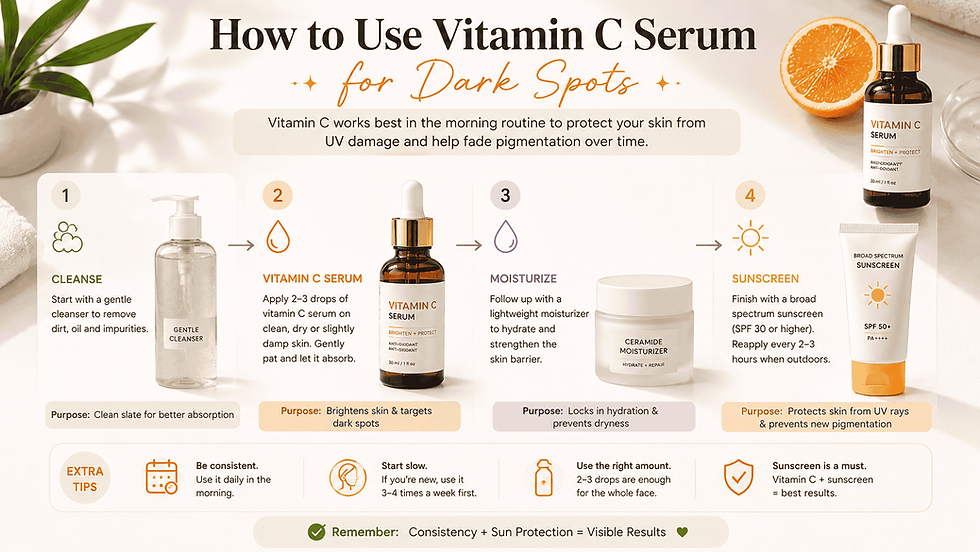
For most people, vitamin C fits easily into a morning skincare routine.
Morning routine
Step 1: Gentle cleanser
Step 2: Vitamin C serum
Step 3: Moisturizer
Step 4: Broad-spectrum sunscreen
Apply a few drops of vitamin C serum to clean, dry or slightly damp skin, depending on the product's directions.
You don't need to use a large amount. More serum does not mean faster pigmentation removal.
Most importantly, finish with sunscreen.
If you're specifically trying to fade acne marks with vitamin C, skipping sunscreen can undermine your efforts because UV exposure can continue stimulating pigmentation.
Can You Use Vitamin C and Sunscreen Together?
Absolutely.
In fact, this is one of the most sensible combinations for a morning routine targeting pigmentation.
Vitamin C provides antioxidant support, while sunscreen protects the skin from UV radiation.
However, vitamin C is not sunscreen.
You still need a broad-spectrum sunscreen with an appropriate SPF and adequate application.
If you have pigmentation, consider sunscreen one of the most important parts of your routine rather than treating it as an optional final step.
Can Vitamin C Fade Acne Marks?
It can help improve the appearance of post-acne discoloration, particularly when combined with consistent sun protection.
But there's an important distinction.
A dark brown or red mark left after acne is different from an actual acne scar involving a change in skin texture.
Vitamin C may help with discoloration, but it won't fill in an indented acne scar.
If your concern is specifically vitamin C for post-acne pigmentation, focus on consistent use rather than expecting overnight changes.
How Long Does Vitamin C Take to Work on
Hyperpigmentation?
Don't judge your serum after three or four days.
Pigmentation is a slow process.
With consistent skincare, you may gradually notice:
Brighter-looking skin
More even skin tone
Less noticeable dark spots
Reduced appearance of post-acne marks
The exact timeline varies depending on the depth and cause of pigmentation, your skin type, sun exposure, and the rest of your routine.
Some pigmentation can take several weeks or longer to improve.
If your pigmentation is getting darker, spreading, or not responding despite consistent skincare, consider consulting a dermatologist rather than continuously adding stronger products.

Vitamin C Serum for Sensitive Skin and Hyperpigmentation
Sensitive skin requires a different approach.
If your skin frequently becomes red, itchy, dry, or irritated after using active ingredients, don't immediately choose a high-strength vitamin C serum.
Instead:
Start with a lower concentration.
Patch test the product.
Use it two or three mornings per week initially.
Apply moisturizer if your skin feels dry.
Increase frequency gradually if your skin tolerates it.
The goal is consistent treatment without damaging your skin barrier.
Vitamin C Mistakes That Can Make Pigmentation Worse
Using vitamin C incorrectly can create more problems than benefits.
1. Starting with an extremely high concentration
More isn't automatically better.
A strong formula can be irritating, particularly if you're new to active skincare.
2. Skipping sunscreen
This is probably the biggest mistake.
If you're treating hyperpigmentation but exposing your skin to UV radiation every day without adequate sunscreen, you're making the job considerably harder.
3. Using too many active ingredients
Combining vitamin C with several exfoliating acids, retinoids, scrubs, and other strong treatments can overwhelm your skin.
4. Applying too much serum
A few drops are generally sufficient.
Using half the bottle won't make dark spots disappear faster.
5. Continuing despite irritation
Persistent burning, redness, or peeling isn't proof that a product is "working."
Irritated skin needs attention, not more active ingredients.
How to Choose the Best Vitamin C Serum for Your Skin Type
For oily skin
Look for:
Lightweight textures
Non-greasy formulas
Moderate vitamin C concentrations
Minimal unnecessary oils
For dry skin
Look for vitamin C combined with hydrating ingredients such as:
Hyaluronic acid
Glycerin
Panthenol
Ceramides
For sensitive skin
Prioritize:
Lower concentrations
Gentle vitamin C derivatives
Fragrance-free formulas when possible
Simple ingredient lists
For acne-prone skin
Look for lightweight, non-comedogenic formulations and avoid introducing several new actives simultaneously.
Vitamin C vs Niacinamide for Hyperpigmentation
If you're wondering whether vitamin C or niacinamide is better for dark spots, you don't necessarily have to choose only one.
If you want to explore best Niacinamide serum for hyperpigmentation then check out our post 'Best Niacinamide Serum for Hyperpigmentation".
Both ingredients can have a place in a pigmentation-focused skincare routine.
Vitamin C is particularly useful for antioxidant protection and brightening, while niacinamide is a versatile ingredient that can support the skin barrier and help improve the appearance of uneven pigmentation.
If you're already using niacinamide and want to add vitamin C, you can generally use them in the same routine as long as your skin tolerates the combination.
The key is not to overload your routine.
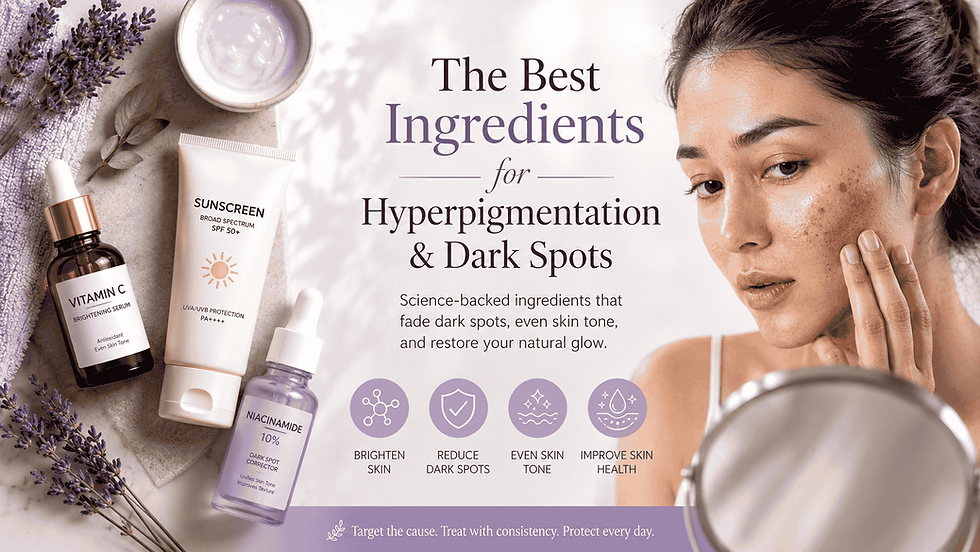
If you are unsure which skincare ingredients you should choose for hyperpigmentation then check out our post Best Ingredients for Hyperpigmentation.
Final Verdict: What Is the Best Vitamin C Serum for Hyperpigmentation?
If you're looking for one accessible option specifically for pigmentation, Plum 15% Vitamin C Serum is a strong choice to consider because it uses 15% ethyl ascorbic acid and is specifically positioned for dark spots and uneven skin tone.
For beginners, a 10% vitamin C serum can be a more sensible starting point than immediately choosing a high-strength formula.
If you have sensitive skin, prioritize tolerance and a gentle formulation over concentration.
And regardless of which serum you choose, remember the most important combination:
Vitamin C + moisturizer + daily sunscreen + consistency.
Vitamin C can support your hyperpigmentation routine, but it isn't a magic eraser for dark spots. Give your skin time, protect it from the sun, and avoid constantly switching products.
Quick Picks
Best overall: Plum 15% Vitamin C Serum
Best beginner strength: 10% vitamin C serum
Best for antioxidant support: Vitamin C + Ferulic Acid formula
Best for sensitive skin: Lower-strength vitamin C derivative
Best for acne marks: Vitamin C + consistent sunscreen
Best routine for pigmentation: Vitamin C + moisturizer + broad-spectrum SPF
If you're building a complete hyperpigmentation skincare routine, vitamin C is only one piece of the puzzle.
Other ingredients such as niacinamide, alpha arbutin, azelaic acid, retinoids, and tranexamic acid may also be useful depending on the type and cause of pigmentation.
The most effective routine isn't necessarily the one with the most products. It's the one your skin can tolerate and you can follow consistently.


Comments