The Natural Skincare Guide: 25 Everyday Secrets for Naturally Healthy, Glowing Skin

Healthy, glowing skin does not always require a complicated 10-step routine or a bathroom shelf filled with expensive products.
In many cases, the foundation of good skin comes from surprisingly simple habits: protecting your skin from the sun, cleansing it gently, staying hydrated, eating a balanced diet, sleeping well, and avoiding practices that quietly damage your skin barrier.
The idea of natural skincare is often misunderstood. Natural skincare does not mean that every ingredient from nature is automatically safe, nor does it mean abandoning scientifically formulated skincare products.
Instead, it means taking a simpler, skin-conscious approach that prioritizes healthy habits, gentle care, and ingredients that support your skin rather than constantly irritating it.
Your skin is a living barrier. It protects you from the outside environment while helping regulate moisture and temperature. When that barrier is healthy, skin generally looks smoother, calmer, and more radiant.
This guide covers 25 everyday natural skincare secrets that can help you build that foundation.
If you are dealing with a specific concern such as hyperpigmentation, acne, dry skin, sensitive skin, or premature skin aging, those topics deserve more detailed guides of their own.
Here, the focus is on the everyday habits that form the foundation of naturally healthy skin.

What Does Natural Skincare Actually Mean?
Before getting into the 25 secrets, it is important to clarify what "natural skincare" means.
Natural skincare can involve:
Gentle cleansing
Sun protection
Adequate hydration
A nutritious diet
Plant-based ingredients
Simple homemade skincare practices
Avoiding unnecessary irritation
Supporting the skin barrier
Maintaining healthy lifestyle habits
However, natural does not automatically mean safe.
Poison ivy is natural. Lemon juice is natural. Essential oils are natural. That does not mean they should be applied directly to your face.
Likewise, a laboratory-made ingredient is not automatically harmful simply because it is synthetic.
A better approach is to ask:
Is this ingredient or habit appropriate for my skin, and does it have a reasonable safety profile?
That mindset will keep your natural skincare routine both simple and sensible.
25 Everyday Secrets for Naturally Healthy, Glowing Skin
1. Treat Your Skin Barrier Like a Protective Shield
Your skin barrier is one of the most important foundations of healthy-looking skin.
The outermost layer of your skin helps prevent excessive water loss while protecting the skin from environmental irritants.
When the barrier becomes compromised, you may notice:
Dryness
Tightness
Flaking
Redness
Increased sensitivity
Burning or stinging
Rough texture
One of the biggest mistakes people make is assuming that aggressive skincare produces better results.
Scrubbing harder, washing repeatedly, or layering multiple strong products can actually make your skin more irritated.
A healthier approach is simple:
Cleanse gently, moisturize appropriately, protect from the sun, and avoid unnecessary irritation.
A strong skin barrier is often the quiet foundation behind that healthy glow everyone wants.

2. Keep Your Skincare Routine Simple
You do not need a huge collection of products to have healthy skin.
A basic routine can often be built around three fundamental steps:
Morning
Gentle cleansing, if needed
Moisturizer
Sunscreen
Night
Gentle cleansing
Moisturizer
Additional products can be introduced depending on individual concerns.
The problem with extremely complicated routines is not simply the number of products.
It becomes difficult to determine which product is helping, which one is irritating your skin, and whether you are unnecessarily combining ingredients.
Start with the basics.
Once those are working well, add targeted products only when there is a genuine reason to do so.

3. Cleanse Without Stripping Your Skin
Cleansing removes sweat, excess oil, sunscreen, makeup, dirt, and environmental particles from the skin.
But cleansing should not leave your face feeling extremely tight or squeaky clean.
That tight sensation can be a sign that you have removed too much oil from the skin's surface.
Choose a gentle cleanser appropriate for your skin type and avoid repeatedly washing your face throughout the day simply because it feels refreshing.
For most people, cleansing at night is particularly important because it removes the accumulation of the day.
If your skin is dry or sensitive, you may need an even gentler approach.
The goal is not to make your skin feel completely oil-free.
The goal is to make it clean without unnecessarily irritating it.
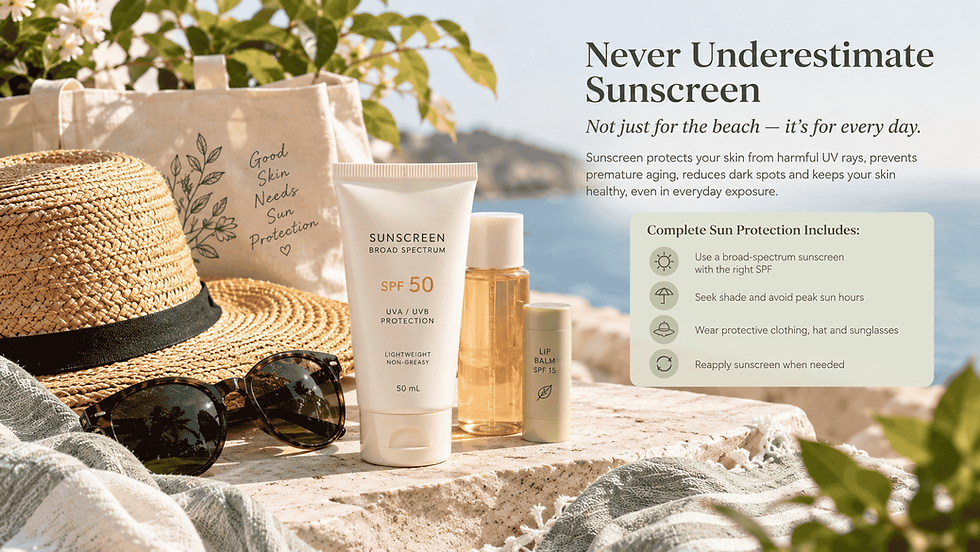
4. Never Underestimate Sunscreen
If there is one skincare habit that deserves to become non-negotiable, it is sun protection.
Ultraviolet radiation contributes to:
Premature skin aging
Uneven skin tone
Dark spots
Hyperpigmentation
Sunburn
Collagen breakdown
This is particularly important if you are trying to maintain an even complexion or fade existing pigmentation.
A broad-spectrum sunscreen with an appropriate SPF can help protect your skin from ongoing UV exposure.
But sunscreen is only one part of sun protection.
You can also:
Seek shade
Wear protective clothing
Use a hat
Avoid unnecessary prolonged exposure during intense sunlight
And remember: sunscreen is not only for beach days.
Daily environmental exposure adds up.
For people specifically concerned about pigmentation, sunscreen deserves a much deeper discussion because application amount, reapplication, UVA protection, visible light, and sunscreen selection can all matter. Those details are best explored separately.
For days when your skin looks dull or feels affected by sun exposure, our guide to homemade face masks for de-tanning offers simple at-home options you can try as part of a gentle skincare routine.
5. Moisturize Even If Your Skin Is Oily
One common misconception is that oily skin does not need moisturizer.
It does.
Moisturizers help support the skin barrier and reduce water loss from the skin.
If you have oily skin, you may simply prefer a lightweight gel or lotion rather than a rich cream.
If you have dry skin, a richer moisturizer may feel more comfortable.
The important thing is to match the texture to your skin's needs rather than eliminating moisturizer altogether.
Healthy skin is not skin that contains no oil.
It is skin whose moisture balance and barrier are being properly supported.
6. Drink Enough Water
Water is essential for overall health, and adequate hydration is important for normal physiological function.
But drinking excessive amounts of water will not magically transform your skin overnight.
Your goal should simply be to drink enough fluids to stay adequately hydrated, especially in hot weather or when physically active.
If you regularly feel thirsty, have very dark urine, or are losing significant fluids through sweating, your hydration needs may be higher.
Instead of obsessing over a magical "glowing skin water intake," focus on consistent hydration throughout the day.
7. Eat for Your Skin, Not Just Your Waistline
Your skin needs nutrients to perform its normal functions.
A balanced diet containing a variety of:
Fruits
Vegetables
Whole grains
Legumes
Nuts
Seeds
Protein-rich foods
Healthy fats
can provide a wide range of vitamins, minerals, antioxidants, and other nutrients.
Colorful fruits and vegetables are particularly useful because they contain different plant compounds.
Rather than searching for one miraculous "skin food," think about dietary variety.
Your skin does not need one superfood.
It needs adequate nutrition consistently.

8. Give Protein a Place on Your Plate
Protein is often discussed in relation to muscles, but it is also important for tissues throughout the body.
A diet that consistently provides adequate protein supports normal tissue maintenance and repair.
Vegetarian sources can include:
Lentils
Beans
Chickpeas
Peas
Soybeans
Tofu
Tempeh
Soy milk
Nuts
Seeds
The exact amount you need depends on your overall diet, body size, activity level, and individual circumstances.
Instead of trying to get all your protein from one food, include different protein sources throughout your meals.
9. Eat More Color
Think of your plate as a palette.
Different colored fruits and vegetables provide different combinations of nutrients and plant compounds.
Try rotating foods such as:
Carrots
Tomatoes
Spinach
Bell peppers
Berries
Papaya
Citrus fruits
Pomegranate
Green leafy vegetables
You do not need expensive imported "superfoods."
Many ordinary local fruits and vegetables can provide excellent nutrition.
A colorful, varied diet is much more useful than chasing one trendy ingredient.
10. Include Healthy Fats
Healthy fats play important roles throughout the body.
Foods such as:
Flaxseeds
Chia seeds
Walnuts
Sesame seeds
Pumpkin seeds
Sunflower seeds
Avocado
can contribute beneficial fats and other nutrients to your diet.
Seeds are particularly useful because they can be added easily to meals.
Try sprinkling them over porridge, adding them to smoothies, mixing them into salads, or incorporating them into homemade meals.
But remember that healthy fats are still calorie-dense, so variety and reasonable portions matter.
11. Stop Treating Your Face Like a Scrubbing Project
Physical exfoliation can make skin temporarily feel smoother, but aggressive scrubbing is not the secret to glowing skin.
Avoid using harsh scrubs containing rough particles that can irritate your skin.
Your skin naturally sheds dead cells.
You do not need to constantly attack the surface to make this process happen.
If you want to use exfoliation, choose an appropriate method and frequency for your skin type.
And if your skin is already irritated, inflamed, peeling, or sensitive, exfoliation may be the last thing it needs.
12. Be Careful With DIY Lemon and Baking Soda Remedies
The internet is full of homemade remedies promising instant brightness.
Some of the most common include lemon juice and baking soda.
These are not harmless skincare shortcuts.
Lemon juice can be irritating and can make skin more vulnerable to problems when exposed to sunlight.
Baking soda is alkaline and can disrupt the skin's natural acidic environment.
The fact that an ingredient exists in your kitchen does not make it appropriate for facial skin.
Natural skincare should be gentle, not reckless.
13. Patch-Test New Ingredients
Even natural ingredients can cause irritation or allergic reactions.
Whenever you introduce a new skincare product or unfamiliar ingredient, test it cautiously rather than immediately covering your entire face.
This is particularly important with:
Essential oils
Botanical extracts
Homemade masks
Fragranced products
New active ingredients
A small test area can help you identify potential problems before applying something extensively.
Patch testing cannot guarantee that a reaction will never occur, but it is a sensible precaution.
14. Do Not Put Every Essential Oil on Your Face
Essential oils are highly concentrated plant extracts.
They may smell pleasant, but concentrated does not mean better.
Undiluted essential oils can irritate the skin and may cause sensitization in some individuals.
If you choose to use products containing essential oils, remember that facial skin is more delicate than many other areas of the body.
You do not need essential oils to have healthy skin.
They are optional, not fundamental.
15. Change Your Pillowcase Regularly
Your pillowcase comes into contact with your face for hours at a time.
Oil, sweat, hair products, skincare residue, and environmental particles can accumulate on fabric.
Changing your pillowcase regularly is a simple hygiene habit.
It is not a miracle acne treatment, but if you frequently sleep on the same unwashed fabric, improving pillowcase hygiene is reasonable.
If you have acne-prone skin, also pay attention to hair products that transfer onto your pillow while you sleep.
16. Keep Your Hands Away From Your Face
Your hands touch countless surfaces throughout the day.
Constantly touching your face can transfer dirt, oils, and other substances to your skin.
More importantly, picking or squeezing pimples can increase inflammation and raise the risk of lingering marks.
If you notice yourself touching your face frequently, simply becoming conscious of the habit can help.
Your face does not need constant handling.
17. Never Sleep With Makeup On
Makeup itself is not necessarily bad for your skin.
The problem is failing to remove it properly.
Sleeping with makeup, sunscreen, sweat, and accumulated oil on your skin is not a good nighttime habit.
Use an appropriate makeup remover or cleansing method and follow with gentle cleansing when necessary.
Your nighttime routine should give your skin a chance to remain clean and comfortable rather than leaving the day's products sitting on it indefinitely.
18. Prioritize Sleep
Skincare products cannot compensate for consistently poor lifestyle habits.
Sleep is important for overall health, and inadequate sleep can affect how you feel and how your skin appears.
After a poor night's sleep, many people notice:
Dull-looking skin
Under-eye darkness
Puffiness
A tired appearance
Aim for a consistent sleep schedule and enough sleep for your age and individual needs.
Think of sleep as part of your skincare routine—even though you cannot put it in a bottle.
19. Learn to Manage Chronic Stress
Stress is unavoidable.
Constant, unmanaged stress, however, can affect many aspects of health and may influence skin conditions in susceptible individuals.
Instead of searching for a skincare ingredient that "cancels out" stress, build habits that help you manage it.
These might include:
Walking
Exercise
Dancing
Meditation
Journaling
Spending time outdoors
Creative hobbies
Maintaining a consistent routine
Your skincare routine should support your lifestyle, not become another source of stress.
20. Exercise Regularly
Exercise supports overall health and circulation.
It can also be beneficial for stress management and sleep.
However, sweat should not be left sitting on the skin unnecessarily.
If you exercise, particularly in hot or humid conditions:
Wear clean workout clothes.
Avoid touching your face unnecessarily.
Cleanse your skin afterward when appropriate.
Replace sweaty clothing.
Shower after particularly sweaty sessions.
Exercise can be good for your overall well-being without needing to become another complicated skincare ritual.
21. Protect Your Skin From Environmental Exposure
Your skin constantly interacts with the environment.
Sunlight, pollution, dust, dry air, wind, and extreme temperatures can all affect how comfortable your skin feels.
You cannot completely isolate your skin from these factors—and you should not try.
Instead, focus on practical protection:
Sunscreen during daytime
Gentle cleansing
Moisturization
Protective clothing when appropriate
Avoiding unnecessary exposure to harsh environmental conditions
A strong skin barrier is your first line of defense.
22. Do Not Change Products Every Week
Skincare requires consistency.
If you introduce a new product every few days, you make it almost impossible to determine what is actually working.
You may also end up irritating your skin by layering too many unfamiliar products.
Instead:
Introduce one significant change at a time.
Give your routine enough time to show whether it suits you, unless you experience irritation or another adverse reaction.
Healthy skin is rarely built through constant experimentation.
It is usually built through boring consistency.
23. Pay Attention to Fragrance and Irritation
Fragrance is not automatically harmful.
However, fragranced products can be irritating for some people, particularly those with sensitive skin.
If your skin frequently feels:
Burning
Itchy
Tight
Red
Unusually sensitive
look at your routine as a whole rather than assuming you need a stronger treatment.
Sometimes the best skincare improvement is simply removing something that your skin does not tolerate well.
24. Give Your Skin Time
This is perhaps one of the most overlooked skincare secrets.
Skin does not transform overnight.
Many skincare concerns develop gradually and therefore improve gradually.
Expecting a homemade mask, serum, or moisturizer to erase years of pigmentation or texture in a few days encourages people to overuse products.
Instead, track progress over weeks and months.
Take photographs under similar lighting conditions if you want to compare changes.
And remember that healthy skin does not mean completely poreless, perfectly even, or permanently glowing skin.
Real skin has pores, texture, pigmentation, fine lines, and occasional imperfections.
The goal is healthy skin, not digitally perfect skin.
25. Build Your Natural Skincare Routine Around Consistency
All 24 habits above become more useful when they work together.
A simple natural skincare lifestyle could look like this:
Morning
Drink water according to your thirst and daily needs.
Eat a balanced breakfast.
Cleanse gently if necessary.
Moisturize.
Apply broad-spectrum sunscreen.
Protect your skin from prolonged direct sunlight.
During the Day
Eat a varied diet.
Include protein-rich foods.
Eat fruits and vegetables.
Drink adequate fluids.
Avoid unnecessary touching or picking.
Reapply sunscreen when appropriate based on your exposure.
Evening
Remove makeup and sunscreen.
Cleanse gently.
Moisturize.
Eat a nourishing dinner.
Give yourself time to unwind.
Aim for consistent, adequate sleep.
Weekly
Change pillowcases and towels regularly.
Review whether any new product is irritating your skin.
Avoid unnecessary aggressive exfoliation.
Prepare nutritious foods rather than relying entirely on quick processed options.
This is not glamorous.
It is effective because it is sustainable.
Natural Skincare Ingredients Worth Knowing
Natural skincare does have a place for plant-derived ingredients, but they should be approached intelligently.
Some commonly used ingredients include:
Aloe Vera
Aloe vera is widely used in soothing and hydrating skincare products.
Green Tea
Green tea contains antioxidant compounds and is frequently incorporated into skincare formulations.
Oatmeal
Oat-based skincare can be useful for soothing and supporting uncomfortable, dry skin.
Honey
Honey has long been used in traditional skincare, although the formulation and purity matter, and applying kitchen ingredients directly to skin is not always appropriate.
Rose Water
Rose-derived products are popular for their sensory qualities, although fragrance-sensitive individuals should still pay attention to how their skin reacts.
Turmeric
Turmeric has a long history of traditional use, but concentrated or homemade turmeric preparations can stain and irritate some skin types.
The important lesson is this:
An ingredient's reputation is not enough. Its concentration, formulation, purity, application, and your individual skin tolerance all matter.
Specific natural ingredients—and how to use them safely—deserve dedicated guides rather than being squeezed into one enormous list.
If you enjoy simple homemade skincare, you can also explore our guide to homemade face masks for glowing skin, with easy options designed to give your skin a fresh, healthy-looking appearance without making your routine complicated.

Natural Skincare Mistakes That Can Backfire
The natural skincare movement has produced some excellent ideas, but it has also created plenty of misinformation.
Avoid these common mistakes:
Using lemon juice as a brightening treatment
Natural does not mean gentle.
Scrubbing every day
More exfoliation does not automatically equal brighter skin.
Using undiluted essential oils
Highly concentrated plant oils can irritate facial skin.
Applying baking soda
Its alkaline nature makes it unsuitable as a routine facial treatment.
Using toothpaste on pimples
Toothpaste is formulated for teeth, not facial skin.
Assuming homemade means chemical-free
Everything is made of chemicals. The relevant question is whether the ingredients are appropriate and safe for their intended use.
Replacing sunscreen with natural oils
Plant oils may provide conditioning benefits, but they should not be treated as a reliable replacement for properly tested sunscreen.
Using too many DIY masks
Constant experimentation can leave your skin irritated rather than glowing.
What About a Completely "Chemical-Free" Skincare Routine?
There is no such thing as a truly chemical-free skincare routine.
Water is a chemical.
Vitamin C is a chemical.
Aloe vera contains chemicals.
Your skin itself is made of chemicals.
The phrase "chemical-free" is therefore not a useful way to evaluate skincare.
Instead, look for products with:
Transparent ingredient lists
Appropriate formulations
Evidence supporting their intended use
Good manufacturing standards
Ingredients your skin tolerates
You can absolutely prefer minimal, plant-based, fragrance-free, or naturally derived skincare.
Just do not let the word natural become a substitute for evaluating safety.

How to Know Whether Your Routine Is Actually Working
Your skincare routine is probably moving in the right direction if your skin feels:
Comfortable
Soft
Less irritated
Adequately hydrated
Relatively balanced
Consistently protected from the sun
For specific concerns, look for gradual changes rather than overnight transformations.
Keep a simple skincare journal if you tend to change products frequently.
Record:
New products
Date introduced
Irritation
Dryness
Breakouts
Changes in pigmentation
Overall skin comfort
This can help you identify patterns.
When Natural Skincare Is Not Enough
Lifestyle habits and gentle skincare can create an excellent foundation, but they cannot treat every skin condition on their own.
Persistent or severe:
Acne
Eczema
Rosacea
Melasma
Severe hyperpigmentation
Unexplained rashes
Persistent itching
Sudden changes in moles or skin lesions
may require professional evaluation.
There is nothing "unnatural" about seeing a dermatologist.
Sometimes the healthiest approach is combining good everyday habits with evidence-based medical treatment.
The Natural Glow Formula
If you want to simplify everything in this guide, remember this formula:
Protect + Nourish + Hydrate + Sleep + Simplify + Stay Consistent
Protect
Use sunscreen and sensible sun protection.
Nourish
Eat a varied, nutrient-rich diet.
Hydrate
Drink enough fluids and moisturize your skin appropriately.
Sleep
Give your body adequate time to recover.
Simplify
Avoid unnecessary products and aggressive DIY treatments.
Stay Consistent
Give healthy habits enough time to work.
That is the foundation of natural skincare.

Final Thoughts
Naturally healthy skin is not created by one magical ingredient.
It is the result of dozens of small decisions repeated consistently.
You protect your skin from the sun.
You cleanse it without stripping it.
You moisturize it.
You eat nourishing foods.
You consume enough protein and healthy fats.
You stay adequately hydrated.
You sleep.
You exercise.
You manage stress.
You avoid picking, excessive scrubbing, and questionable DIY treatments.
And most importantly, you learn to work with your skin instead of constantly fighting it.
Natural skincare does not have to mean abandoning modern skincare. It means stripping away the unnecessary noise and focusing on what genuinely supports healthy skin.
If you are building your routine from scratch, start small.
A gentle cleanser, moisturizer, sunscreen, nourishing diet, adequate sleep, and consistent habits can take you much further than a cabinet full of products that you constantly switch.
And once your foundation is strong, you can address individual concerns more strategically.
Whether your goal is fading hyperpigmentation, managing acne, improving dry skin, supporting sensitive skin, or maintaining youthful-looking skin, each of those topics deserves its own deeper approach.
Healthy skin is not about doing more. Often, it is about doing the right things consistently.


Comments